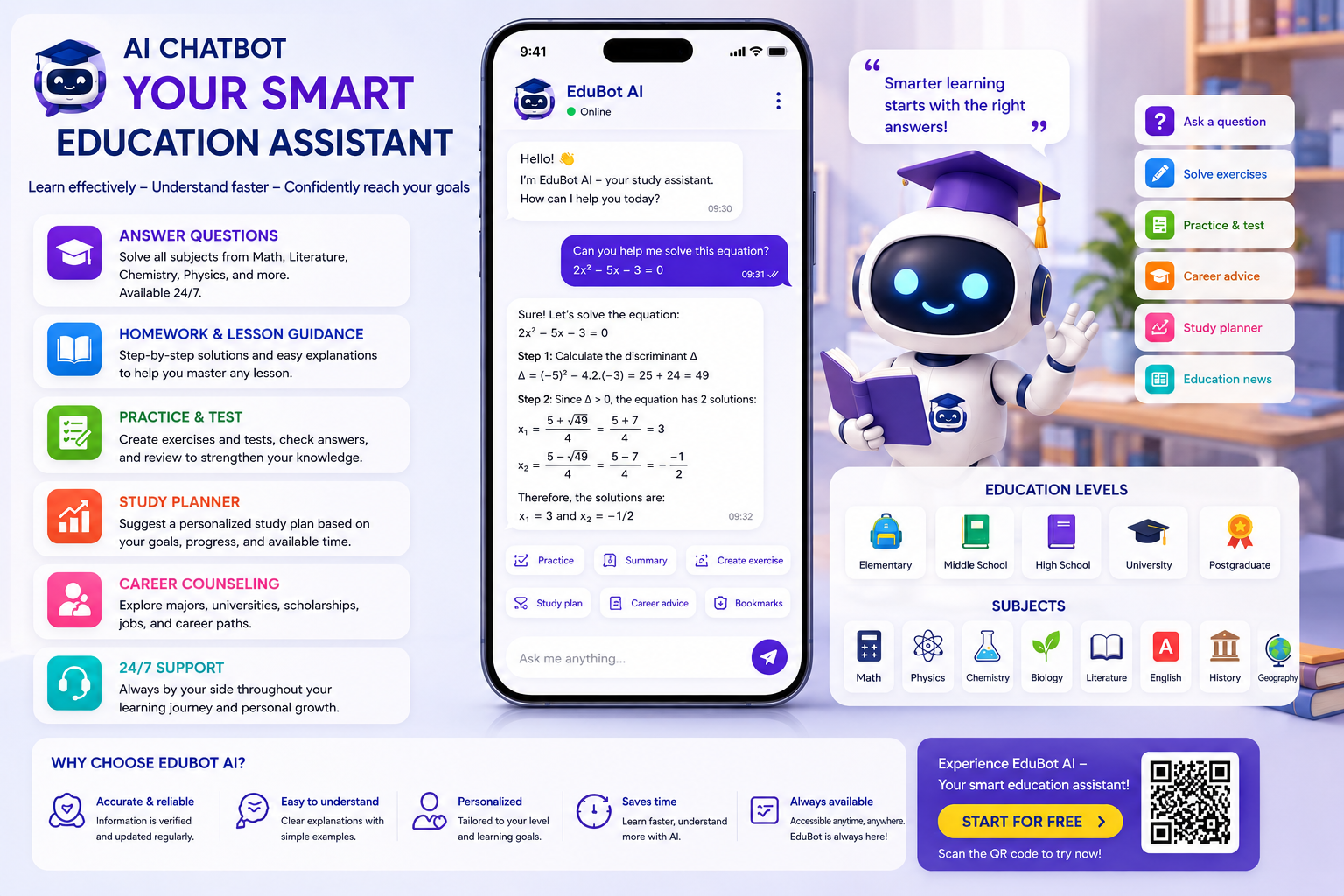
Why VIS Chatbot AI Should Be Applied in the Education Sector
1. Personalized Learning – Tailored Knowledge for Every
Student
One of the greatest challenges in traditional classrooms is
the “one‑size‑fits‑all” approach. Teachers often struggle to monitor and adapt
to each student’s learning pace.
VIS Chatbot AI directly addresses this challenge:
- Flexible
Learning Pace Students can learn at their own speed. When a concept is
difficult, the chatbot can re‑explain it using real‑life examples, images,
or mind maps until comprehension is achieved.
- Targeted
Weakness Analysis By analysing student responses, VIS Chatbot
identifies knowledge gaps and recommends focused practice exercises.
- Adaptation
to Learning Styles Whether a student learns best through visuals,
audio, or hands‑on practice, VIS Chatbot adjusts content delivery
accordingly.
2. 24/7 Support – A Virtual Tutor Always Available
Learning does not stop after school hours. As the document
notes, students often struggle with homework or exam preparation when teachers
are unavailable.
VIS Chatbot AI provides:
- Instant
Answers Students receive explanations within seconds, helping them
stay engaged and productive.
- A
Judgment‑Free Environment Learners can ask questions freely without
fear of embarrassment or repetition.
3. Enhanced Teacher Support – Reducing Administrative
Burden
AI is not a replacement for teachers—it is a powerful
support tool that allows educators to focus on creativity, mentorship, and
student engagement.
VIS Chatbot AI assists by:
- Automating
Grading and Feedback The system can grade multiple‑choice tests and
provide preliminary feedback on essays, including grammar and structure.
- Streamlining
Classroom Management AI can respond to frequently asked questions
about schedules, rules, or materials, saving teachers valuable time.
- Supporting
Lesson Design Teachers can use AI to generate lesson ideas, create
question banks, or summarize complex documents.
4. Promoting Fairness and Expanding Access to Education
VIS Chatbot AI helps close the education gap by offering:
- Multilingual
Support Students from different countries can access knowledge in
their preferred language without barriers.
- Accessibility
Features Integrated text‑to‑speech and speech‑to‑text functions
support learners with disabilities.
- Low‑Cost
Learning Opportunities Many AI chatbot platforms are affordable or
free, making quality education more accessible.
5. Strengthening Critical Thinking and Problem‑Solving
Skills
In the future, the ability to ask the right questions and
verify information will be more valuable than memorizing facts.
VIS Chatbot AI encourages:
- Effective
Questioning Skills Students learn to articulate problems clearly to
receive accurate AI responses.
- Interactive,
Multi‑Perspective Dialogue Learners can engage in role‑play
scenarios—such as debating with a historical figure—to broaden their
understanding.
6. Challenges and Solutions
While AI chatbots offer significant benefits, they also
present challenges that must be addressed:
- Accuracy
AI may occasionally provide incorrect or unclear information. Students
must be trained in information verification.
- Academic
Integrity There is a risk of students misusing AI to complete
assignments. Educators should emphasize critical thinking and practical
application.
- Data
Security Strong legal and technical safeguards are required to protect
student information from potential exposure.
Conclusion
The adoption of AI chatbots in education is an inevitable
and strategic trend. As the document states, “By taking advantage of the
power of AI, we are building a smarter education system, where everyone has the
opportunity to develop.” Educators who embrace AI will be better equipped
to guide, inspire, and empower the next generation of learners.
0 Comments
No data