Why Should You Use AI Chatbots for Restaurants?
What is an AI chatbot in the restaurant model?
An AI chatbot is an automated communication system powered
by artificial intelligence that interacts with customers across websites,
Facebook, Zalo, and other messaging platforms. Unlike traditional scripted
chatbots, modern AI chatbots understand customer intent more flexibly, provide
natural responses, and handle a wide range of real‑world scenarios.
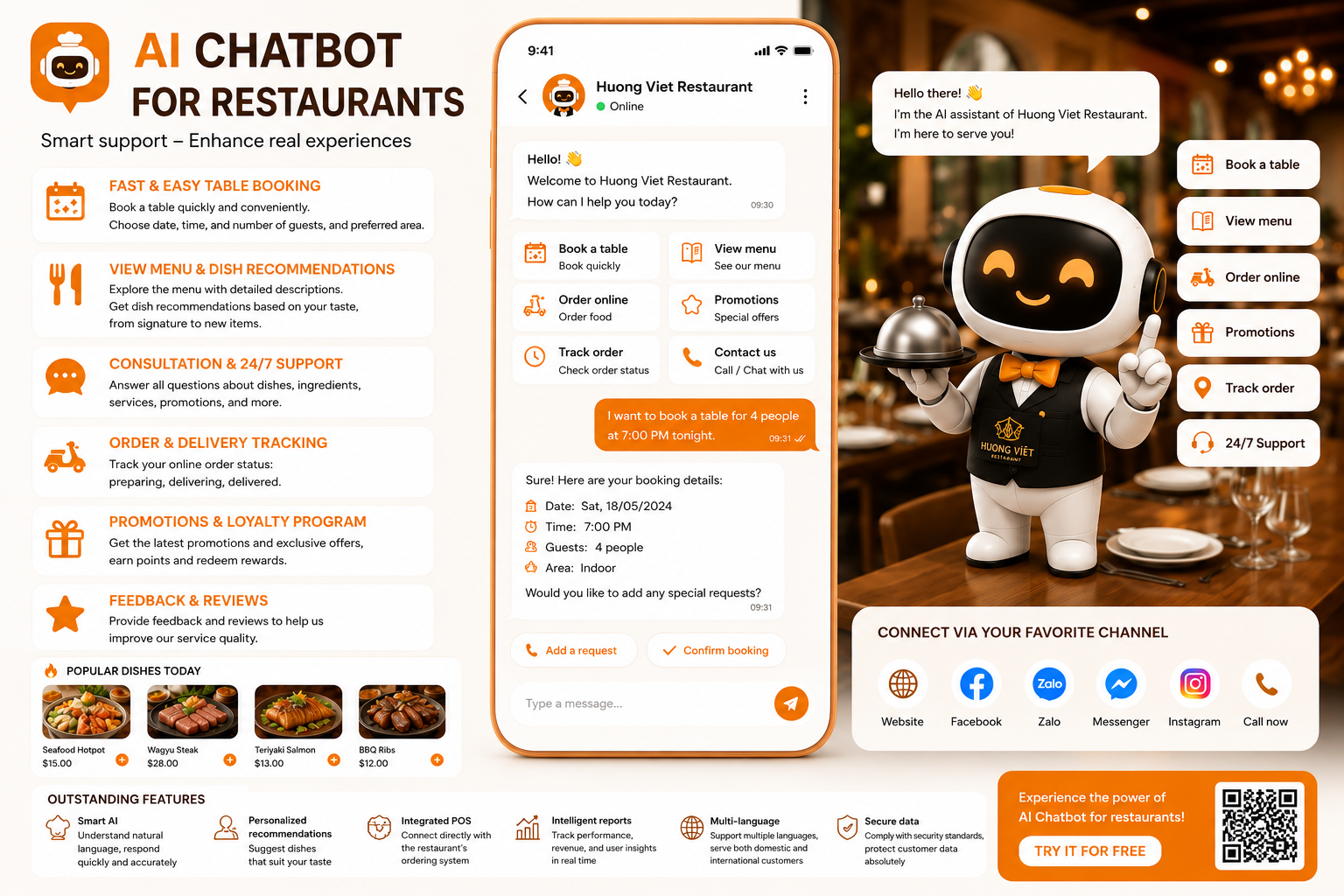
In a restaurant environment, AI chatbots can instantly
answer frequently asked questions about opening hours, locations, branches, and
service policies. They can also introduce menus, highlight signature or
seasonal dishes, recommend family combos, and support upselling without
requiring staff involvement. AI chatbots assist with table reservations,
promote ongoing offers, and streamline online ordering and delivery. They also
collect customer satisfaction data to support continuous service improvement.
In essence, AI chatbots automate the majority of repetitive
customer conversations that staff previously handled manually every day.
Why Should Restaurants Use AI Chatbots?
1. Significantly faster customer response
In the F&B sector, response speed directly influences
conversion. Customers often message multiple restaurants at once with questions
such as “Is there a table available tonight?” or “Which branch is
closest to me?”. Slow replies result in lost business.
AI chatbots respond instantly — during lunch rushes,
evenings, weekends, and holidays — ensuring restaurants never lose customers
due to delayed communication.
2. Reduced operational pressure
Restaurant teams already juggle guest service, kitchen
coordination, and on‑site issue resolution. Constantly replying to repetitive
messages reduces productivity and increases the likelihood of errors.
AI chatbots offload routine communication, allowing staff to
focus on high‑value, complex, or emotional customer interactions. This leads to
a leaner, more efficient operation.
3. Prevent missed customer inquiries
During peak hours, manual message handling often results in
overlooked inquiries — not due to poor food quality, but simply because staff
cannot keep up.
AI chatbots never tire, forget, or become overloaded. They
can manage dozens or even hundreds of conversations simultaneously, a critical
advantage for busy restaurants or those running online promotions.
4. Higher reservation and order‑conversion rates
A customer asking a question is only a potential lead.
Converting them requires guiding the conversation toward action.
AI chatbots proactively collect booking details — number of
guests, preferred time, branch, special occasions, contact information — and
move customers forward in their decision journey. This structured flow directly
increases revenue.
Long‑Term Advantages of AI Chatbots for Restaurant
Development
1. Revenue growth without proportional staffing costs
As customer volume increases, so do inquiries about
reservations, delivery, promotions, and menu items. Handling this manually
requires additional staff.
AI chatbots enable restaurants to scale communication and
service capacity without expanding headcount. A well‑designed system can
replace the repetitive workload of multiple employees, creating clear cost
efficiencies.
2. More professional and consistent brand image
Fast, clear, and consistent communication builds trust. In a
market where customers make quick decisions, professionalism directly
influences booking behavior.
AI chatbots ensure every customer receives accurate
information about menus, pricing, operating hours, promotions, and policies —
creating a stable, reliable brand experience.
3. Stronger marketing performance
Many restaurants invest in advertising but fail to convert
leads due to slow or inconsistent responses.
AI chatbots bridge marketing and sales by instantly engaging
customers from ads, recommending suitable dishes, capturing contact
information, and driving reservations. This maximizes the ROI of advertising
spend.
4. Personalized customer experiences at scale
Unlike old‑style autoresponders, AI chatbots can identify
customer preferences — vegetarian options, family gatherings, birthdays,
buffets, group meals, fast delivery, or daily deals — and tailor
recommendations accordingly.
Personalized guidance increases conversion rates and
enhances customer satisfaction.
5. Valuable customer data for strategic decisions
Every conversation generates insights: most‑requested
dishes, peak reservation times, popular branches, frequently asked promotions,
and more. Restaurants can use this data to refine menus, design targeted
combos, optimize staffing, and build more effective marketing campaigns.
While many view chatbots as simple response tools, their
deeper value lies in enabling restaurants to understand customer behavior more
clearly.
Which Restaurant Models Benefit Most from AI Chatbots?
AI chatbots are especially impactful for:
- Restaurants
with high daily message volume
- Restaurants
offering table reservations
- Multi‑branch
chains
- Buffet,
hot pot, and group‑dining concepts
- Restaurants
running Facebook, Google, or TikTok ads
- Restaurants
offering takeout or delivery
- F&B
brands seeking structured, scalable customer care
For these models, AI chatbots are no longer a “nice to have”
— they are a competitive necessity.
Key Considerations When Implementing AI Chatbots
AI chatbots do not replace human staff. Restaurants still
need personnel to handle complex, emotional, or exceptional cases. The
chatbot’s role is to manage routine, repetitive tasks quickly and consistently,
while humans focus on high‑value interactions.
Additionally, chatbot performance depends on data quality.
Incorrect menus, prices, promotions, or reservation procedures will lead to
inaccurate responses and customer dissatisfaction.
Conclusion
AI chatbots are a practical, high‑impact tool that directly
improves restaurant operations and revenue. They accelerate customer response
times, reduce staff workload, prevent missed inquiries, increase reservation
and order conversions, support marketing efficiency, and lay the foundation for
digital transformation.
Their greatest advantage is scalability: enabling
restaurants to serve more customers, more professionally, and more
intelligently — without expanding operational overhead.
In a highly competitive market, restaurants relying solely
on manual processes will struggle to keep pace with those leveraging AI to
optimize customer experience. AI does not replace humans; it empowers them and
accelerates business growth.
0 Comments
No data